
Whitepaper
Wire-Laser Hybrid Manufacturing: A Risk-Reduction Framework for Advanced Supply Chains
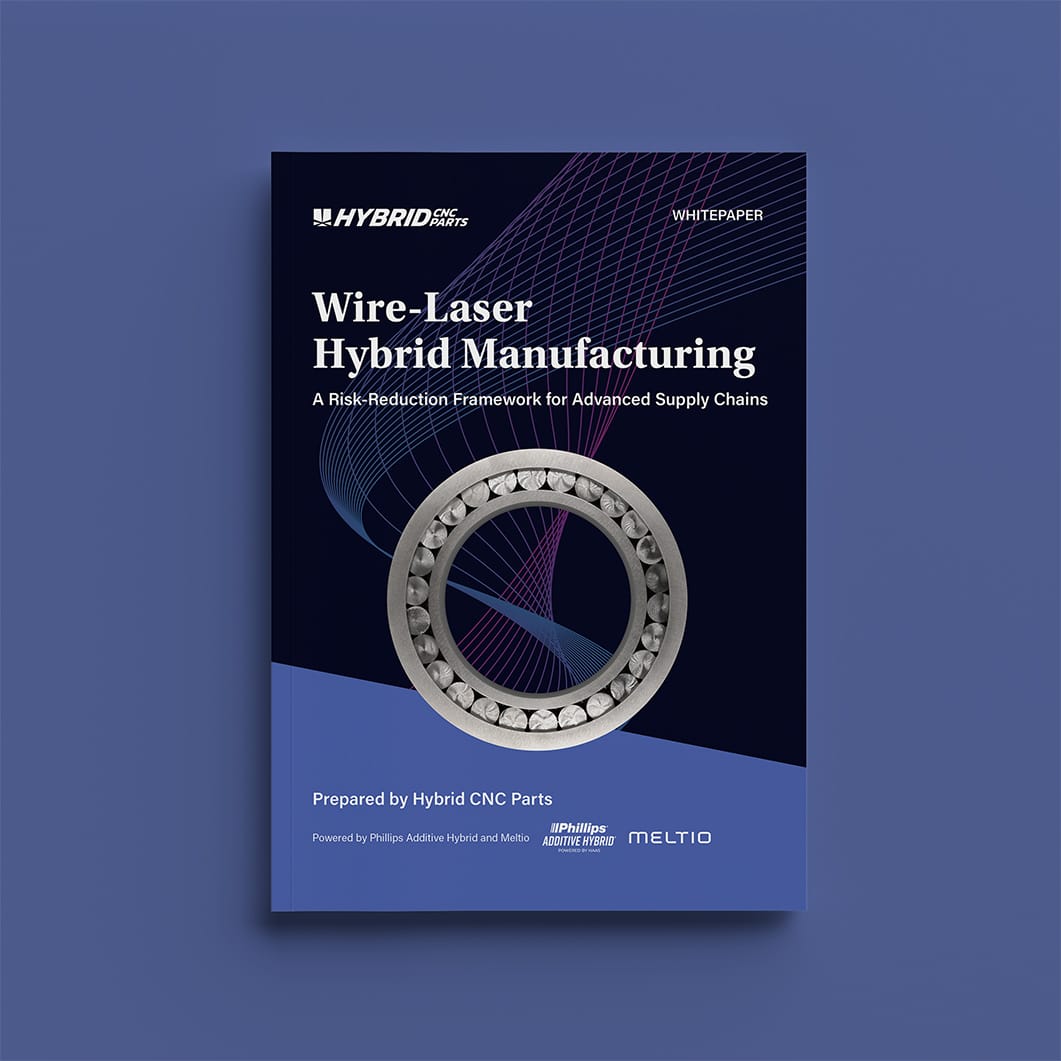
Published: January 2026
Pages: 12
Format: PDF
Size: 1 MB
Get the Whitepaper
Subscribe to the HCP newsletter and receive instant access to the PDF-version of the whitepaper.
By subscribing, you will be added to our regular newsletter mailing list. We respect your privacy and will never sell or share your information. Unsubscribe at any time.
Reduce Risk Without Reinventing Your Process
Organizations developing or sustaining high-performance metal components increasingly face a mismatch between application demands and what conventional manufacturing workflows can reliably deliver.
Advanced alloys, complex geometries, and aggressive operating environments often drive long, multi-step supply chains, increasing exposure to extended lead times, late-stage scrap, and dependency on specialized external suppliers—at the same time that program schedules and qualification pressures continue to tighten.
Wire-laser hybrid manufacturing offers a practical solution to these constraints. By integrating metal additive builds and CNC machining within a single, controlled workflow, hybrid processes enable near-net parts to be produced and finished with fewer handoffs, reduced process complexity, and clearer accountability across manufacturing steps.
Hybrid manufacturing is not a replacement for conventional machining. Rather, it extends established machining practices with targeted additive capability—preserving dimensional control and inspection discipline while reducing supply-chain fragility and risk concentration in high-performance manufacturing programs.
Get the Whitepaper
Subscribe to the HCP newsletter and receive instant access to the PDF-version of the whitepaper.
By subscribing, you will be added to our regular newsletter mailing list. We respect your privacy and will never sell or share your information. Unsubscribe at any time.
What's In the Whitepaper
- How wire-laser hybrid manufacturing integrates additive deposition and CNC machining into a single, production-ready workflow.
- Why conventional supply chains break down for high-performance metal components, particularly in low-volume, schedule-critical, or highly-regulated programs.
- How wire-laser hybrid manufacturing reduces supply-chain risk by addressing common issues such as long lead times, late-stage scrap, and fragmented traceability.
- Why disciplined documentation, inspection, and upfront part selection are essential to realizing wire-laser hybrid manufacturing’s risk-reduction benefits in regulated environments.
- How a risk-based framework can be used to identify when wire-laser hybrid manufacturing is most effective, illustrated through use cases.

Who Is It For?
This whitepaper is for teams working on metal components where conventional manufacturing approaches struggle to deliver predictable outcomes. It's most useful when the challenge is not simply making a part, but managing risk across design, qualification, and production.
It is particularly relevant for projects involving:
- Unique Parts: Low-volume, high-complexity, or first-of-kind components.
- Long Lead Times: Casting, forging, tooling, or limited supplier availability that create too-long lead times.
- High-Value Materials: When scrap, rework, or buy-to-fly ratios would significantly impact cost.
- Demanding Operating Environments: Including extreme temperatures, corrosion, abrasion, and wear.
- Tight Schedules: When delays would create outsized cost-of-delay risk.
- Superior Traceability: When traceability, inspection discipline, or formal qualification are non-negotiable—particularly in regulated or high-consequence environments.
- Targeted Performance Upgrades: Components that would benefit from targeted material performance without upgrading the entire part.
 LinkedIn
 Substack
 ISO 9001/AS9100