
Whitepaper
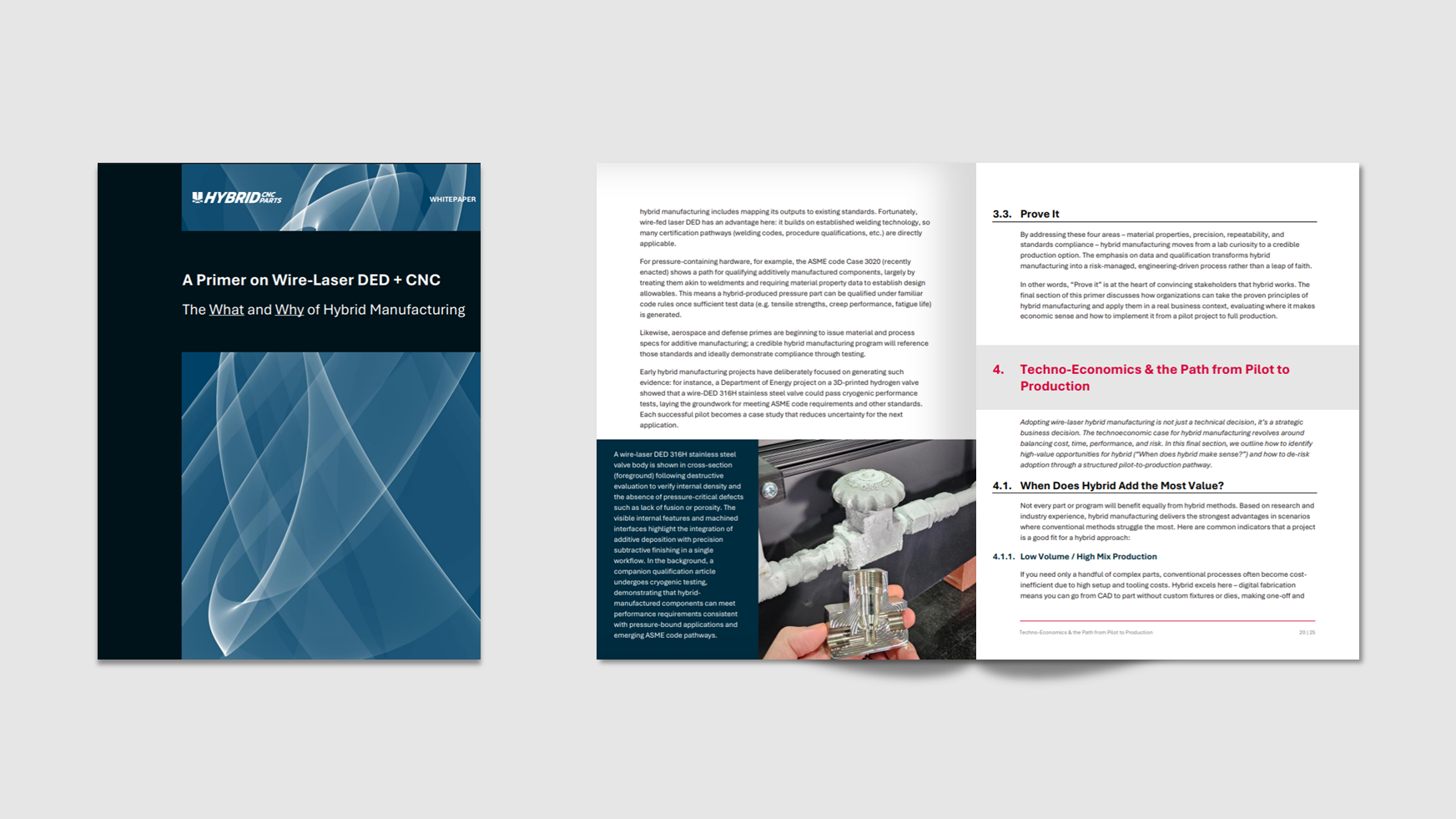
A Primer on Wire-Laser DED and CNC
Published: April 2026
Pages: 27
Format: PDF
Size: 2 MB
Get the Whitepaper
Subscribe to the HCP newsletter and receive instant access to the PDF-version of the whitepaper.
By subscribing, you will be added to our regular newsletter mailing list. We respect your privacy and will never sell or share your information. Unsubscribe at any time.
See Hybrid Manufacturing Clearly, Without Getting Lost in the Hype
Organizations building with high-performance metal parts are under growing pressure to deliver complex geometries, advanced alloys, and tighter qualification packages on shorter timelines—yet many teams still lack a clear, practical understanding of how wire-laser DED actually behaves on the shop floor, and what changes when it’s integrated with CNC machining.
That knowledge gap drives risk. Without a grounded view of deposition physics, workflow planning, inspection strategy, and where hybrid fits (and doesn’t fit), programs can overestimate capability, underestimate qualification effort, or miss the specific use-cases where hybrid meaningfully reduces lead time, scrap exposure, and supply-chain fragility.
This primer on wire-laser directed energy deposition (DED) and CNC machining breaks the process down into an engineer-friendly manufacturing workflow—showing how additive build and subtractive finishing can be combined in a single, controlled setup to produce near-net parts with fewer handoffs and clearer accountability across steps.
Hybrid is not a replacement for machining. It’s a way to extend established CNC discipline with targeted additive capability—helping engineering and program leaders evaluate hybrid with confidence, align it to standards and evidence, and chart a practical path from seeing the process to proving it and ultimately producing real hardware at scale.
Get the Whitepaper
Subscribe to the HCP newsletter and receive instant access to the PDF-version of the whitepaper.
By subscribing, you will be added to our regular newsletter mailing list. We respect your privacy and will never sell or share your information. Unsubscribe at any time.
What's In the Whitepaper
- How DED and CNC machining combine into a single hybrid workflow—from CAD/CAM planning through deposition, in-process machining, optional heat treatment, and finish machining without unnecessary handoffs.
- What to expect from the process in practice—typical deposition strategies, where tolerances come from, how datums are preserved, and what "production-ready" means when additive and subtractive live in one setup.
- How teams "prove it" for critical hardware—the evidence package, inspection and NDE considerations, repeatability controls, and how standards like AMS7010 and AWS D20.1 shape qualification expectations.
- How to decide when hybrid makes business sense—a risk-and-economics lens for part selection (lead time, scrap exposure, low volume/high mix, multi-material needs, obsolescence) plus a staged roadmap from pilot to repeat production.
Who Is It For?
This primer is for teams working on high-performance metal components who need a clear, practical understanding of wire-laser DED and CNC machining—especially when "additive manufacturing" is being considered, but the real challenge is making sound decisions across process planning, verification, and production adoption.
It is particularly relevant for projects involving:
- First-Time Evaluations: Engineering and manufacturing teams who need a grounded overview before committing to equipment, suppliers, or pilot builds.
- Hybrid Workflow Decisions: Parts where the question isn’t "can we print it," but how deposition and machining sequence, datums, and inspection planning make or break outcomes.
- Hard Materials & Real Constraints: Programs using tool steels, stainless, nickel alloys, titanium, or other difficult materials—where rework and scrap are expensive and schedule risk is high.
- Qualification-Driven Environments: When documentation, traceability, controlled variables, and evidence packages matter as much as geometry—especially in regulated or high-consequence applications.
- Demand for Predictable Outcomes: Teams looking to reduce uncertainty by understanding process controls, repeatability, and what "proving it" looks like (standards, test plans, NDE/inspection strategy).
- Lead-Time or Supply Chain Pressure: Components where long external queues (forging/casting/tooling/specialty suppliers) create program risk, and hybrid is being explored as a way to regain control.
- Targeted Performance Needs: Parts that could benefit from adding material only where needed (repair, reinforcement, wear surfaces, localized upgrades) while still relying on CNC for final precision.
 LinkedIn
 Substack
 ISO 9001/AS9100